


























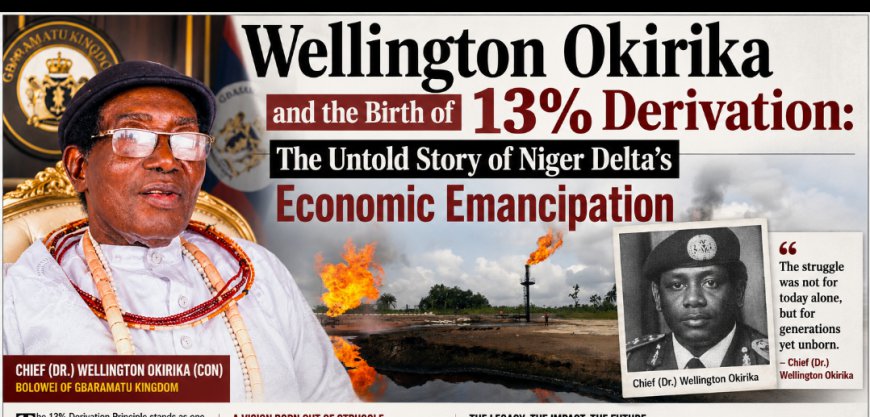
Wellington Okirika and the Birth of 13% Derivation: The Untold Story of Niger Delta’s Economic Emancipation



By Ezekiel Kagbala
Editorial
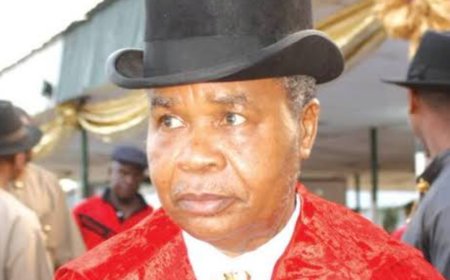
In the history of Nigeria’s struggle for justice, equity, and balanced federalism, certain individuals stand out not merely as participants in national debates but as architects of enduring reforms. One such figure is Chief (Dr.) Wellington O. Okirika, widely revered across the Niger Delta as “Mr. 13% Derivation Fund.”
His relentless advocacy for resource control and equitable revenue sharing helped reshape Nigeria’s fiscal landscape and offered oil-producing communities a constitutional pathway to economic empowerment. Long before the 13 percent derivation principle became a constitutional provision in the 1999 Constitution, Okirika had already dedicated his life to championing the cause of the Niger Delta arguing that communities whose lands and waters generate the nation’s wealth must not remain trapped in poverty and environmental degradation.
Today, as Nigeria continues to rely heavily on oil revenues, the story of how the 13% derivation principle emerged remains incomplete without recognizing the vision, courage, and leadership of Wellington Okirika.
The Struggle for Resource Justice
In the annals of Nigeria’s journey toward resource control and regional development, few figures loom as large as Chief Wellington Okirika.
Honoured across the Niger Delta and beyond as “Mr. 13 Percent Derivation Fund,” his name has become synonymous with the historic campaign to ensure that oil-producing regions receive a fair share of the wealth generated from their natural resources.
For Okirika, the fight for derivation was not merely about revenue allocation; it was about justice, dignity, and survival for the people of the Niger Delta.
Communities that produced the oil which sustained Nigeria’s economy were grappling with environmental devastation, oil spills that destroyed farmlands, gas flaring that polluted the air, and deforestation that threatened livelihoods. Yet, despite these sacrifices, the benefits of oil wealth rarely reached the local population.
This reality compelled Okirika to embark on what would become a lifelong campaign for economic emancipation in the Niger Delta.
Early Campaigns and the Quest for Autonomy before the national conversation on derivation gained momentum, Okirika had already established himself as a defender of the political and cultural rights of Niger Delta communities. From the earliest campaigns to secure traditional autonomy for Ijaw kingdoms in Warri and other oil-bearing communities, he demonstrated a deep commitment to preserving the identity and rights of indigenous peoples.
However, Okirika soon realized that political recognition alone would not address the underlying economic injustices confronting the region. Without equitable access to oil revenues, autonomy would remain symbolic rather than transformative. This realization strengthened his resolve to push for a new national conversation on resource control and derivation, the Birth of the Derivation Movement by the late 1980s and early 1990s, Nigeria’s oil revenues were rising significantly, yet the Niger Delta remained plagued by poverty and neglect.
For Okirika, this contradiction represented a moral and economic failure of the Nigerian federation. His advocacy centered on the principle of “derivation” the idea that states and communities that produce natural resources should receive a fair percentage of the revenue generated from them. At the time, the derivation allocation to oil-producing areas had been drastically reduced over the years, leaving host communities with little or no benefit from their resources.
Okirika’s campaign sought to reverse this injustice and restore a meaningful derivation formula that would empower oil-producing states to develop their communities, from 1.5% to 3%.
In 1985, during the military administration of General Ibrahim Babangida, the Federal Government increased the derivation formula from 1.5 percent to 3 percent. While the increment appeared significant at the time, the arrangement was poorly managed.
Funds were often distributed without transparency, and no institutional mechanism existed to ensure that the money reached the oil-producing communities for which it was intended.
When the Derivation Management Committee was later dissolved over allegations of mismanagement, Okirika mobilized legal and public pressure to challenge the decision. His intervention helped force the reinstatement of the committee and introduced greater scrutiny into the management of derivation funds.
Although the increase from 1.5 percent to 3 percent was modest, it marked an important milestone in the broader struggle for resource justice.
Recognizing that fragmented advocacy would not achieve lasting reform, Okirika embarked on a mission to unite oil-producing communities across ethnic and regional lines.
In 1992, he convened traditional rulers from various oil-bearing regions including the Ijaw, Itsekiri, Urhobo, Isoko, Ndokwa, and others to form the Traditional Rulers of Oil Mineral Producing Communities of Nigeria (TROMPCON).
The organization served as a powerful platform for collective advocacy, bringing together community leaders to demand equitable resource distribution and development.
Through TROMPCON and other coalition platforms such as OMPCON, Okirika helped transform scattered grievances into a coordinated national movement for resource justice.
By mobilizing traditional institutions, political leaders, and grassroots stakeholders, he elevated the derivation struggle from a regional complaint to a national policy issue.
Institutional Vision: From Advocacy to Development
Okirika’s vision extended beyond advocacy. He understood that securing derivation funds would be meaningless without institutions capable of translating resources into development.
This thinking influenced the creation of the Delta State Oil Producing Areas Development Commission (DESOPADEC), an institution designed to channel development projects directly to oil-producing communities. His proposals for community-owned modular refineries also reflected a forward-thinking approach to local economic empowerment and energy participation.
Through these initiatives, Okirika demonstrated that the Niger Delta’s future required not only revenue allocation but also strategic investment in local development.
For Chief Wellington Okirika, the emancipation of the Niger Delta was never a temporary campaign it was a lifelong mission rooted in justice, equity, and human dignity. His advocacy helped lay the foundation for the eventual inclusion of the 13 percent derivation principle in Nigeria’s 1999 Constitution, a milestone that significantly increased revenue allocation to oil-producing states.
Today, the derivation principle continues to shape Nigeria’s fiscal federalism and remains a vital instrument for regional development in the Niger Delta.
Okirika’s legacy therefore transcends regional recognition. It represents a national lesson in how persistence, unity, and principled advocacy can transform long-standing injustices into lasting constitutional reforms.
Part 2 of this series will examine how the struggle for derivation eventually culminated in the constitutional recognition of the 13% derivation principle and the broader impact it has had on Nigeria’s economic and political landscape.
What's Your Reaction?
 Like
0
Like
0
 Dislike
0
Dislike
0
 Love
0
Love
0
 Funny
0
Funny
0
 Angry
0
Angry
0
 Sad
0
Sad
0
 Wow
0
Wow
0