




















Drug Abuse: CDHR, NDLEA, CADAAI Team Up for Campaign in Delta, Demand Probe of Security Exhibit Rooms



By Ezekiel Kagbala
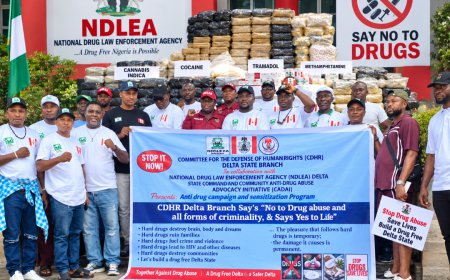
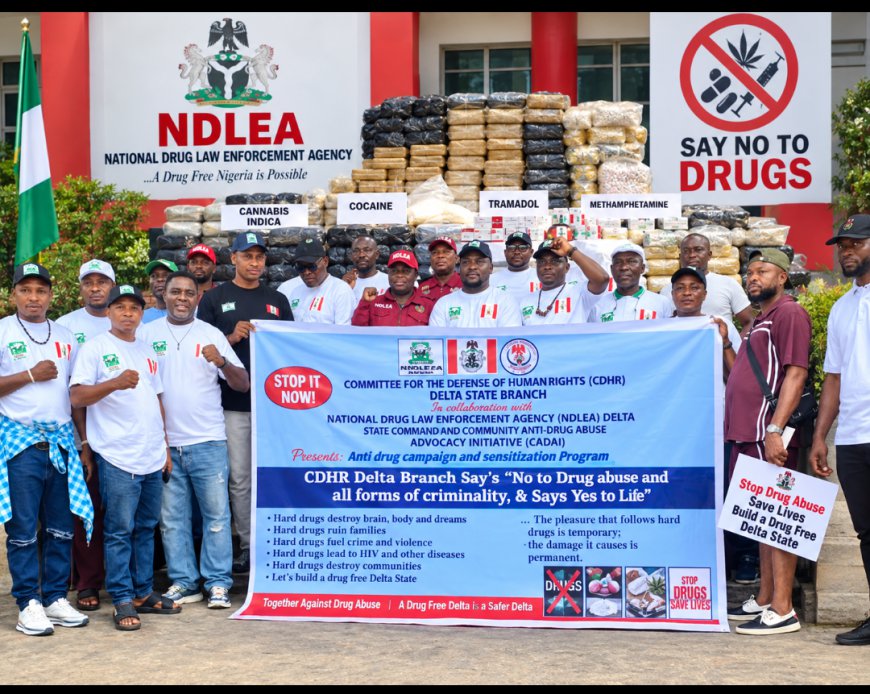
The Committee for the Defence of Human Rights (CDHR), Delta State Branch, in collaboration with the National Drug Law Enforcement Agency (NDLEA), Delta State Command, through the Warri Area Command, and the Community Anti-Drugs Abuse Advocacy Initiative (CADAAI), has intensified the campaign against drug abuse and trafficking across Delta State.
The anti-drug sensitization programme, led by the CDHR Delta State Chairman, Comrade Derrick Oritsematosan Agberen, was held across Warri South, Uvwie and Udu Local Government Areas, on thursday, September 17, 2026 with emphasis on teenagers and young adults and the dangers associated with illicit drug use.
The organisers urged young people to reject substance abuse, warning that drug addiction can have serious consequences for health, education, family life, productivity and community security.
Agberen commended the Nigeria Police Force and the NDLEA for their efforts in combating drug abuse and trafficking, but called for greater transparency and accountability in the handling of confiscated narcotics.
CDHR Questions Movement of Drugs Through Security Checkpoints
Speaking during the campaign, Agberen questioned how illicit drugs continue to circulate in communities despite the presence of security personnel and checkpoints on major roads.
“Despite the heavy presence of security operatives on our state and federal roads, drug abuse and trafficking is still on the rise in Delta. How do these illicit substances beat security checkpoints to get into our communities?”
He subsequently called for an independent and transparent examination of drug exhibits held at police and NDLEA formations, saying such an exercise could strengthen public confidence in the anti-drug campaign.
Agberen alleged, without presenting evidence at the event, that some confiscated substances could be finding their way back into circulation. He therefore demanded an audit to establish the status and chain of custody of seized exhibits.
“What happens to the majority of hard drugs confiscated from dealers? We allege that most of these products are recycled back into society. Only a few end up in exhibit rooms while little is destroyed.”
The allegation is a serious one and would require investigation and documentary evidence to establish. NDLEA's published materials, however, show that the agency maintains custody of drug exhibits as part of its operational responsibilities and has conducted court-authorised public destruction exercises. In August 2026, for example, the agency said it publicly destroyed more than 329,865 kilogrammes of assorted illicit drugs in Lagos following court orders.
The CDHR called for Greater sincerity and transparency by all security agencies involved in the fight against drug abuse and trafficking;
An immediate audit of drug exhibits held at police and NDLEA formations, with appropriate court-authorised destruction of exhibits where legally permissible;
Expanded school and community sensitisation programmes to prevent young people from becoming involved in drug abuse; and Greater protection, treatment and rehabilitation for victims of substance abuse.
The demands come as the NDLEA Delta Command says it has intensified enforcement operations in the state. The command recently reported seizures of about 2.446 tonnes of illicit drugs valued at an estimated ₦2 billion, alongside 248 convictions between July 2025 and September 2026.
The NDLEA's mandate also includes drug prevention, counselling and rehabilitation, alongside interdiction and enforcement activities.
National Drug Law Enforcement Agency “Delta Youths Deserve a Drug-Free Future”
Agberen stressed that enforcement alone would not end drug abuse without sustained prevention, public education, treatment and community participation.
“We cannot win this war if those trusted to fight it are compromised. Delta youths deserve a drug-free future.”
The campaign therefore called for stronger collaboration among security agencies, civil society organisations, schools, families and communities to address both the supply and demand sides of the drug problem.
What's Your Reaction?
 Like
0
Like
0
 Dislike
0
Dislike
0
 Love
0
Love
0
 Funny
0
Funny
0
 Angry
0
Angry
0
 Sad
0
Sad
0
 Wow
0
Wow
0