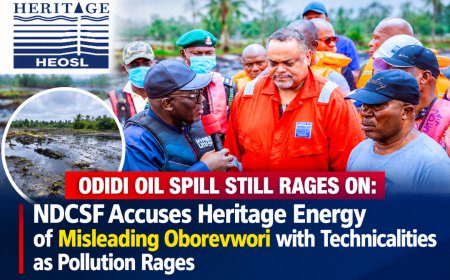



























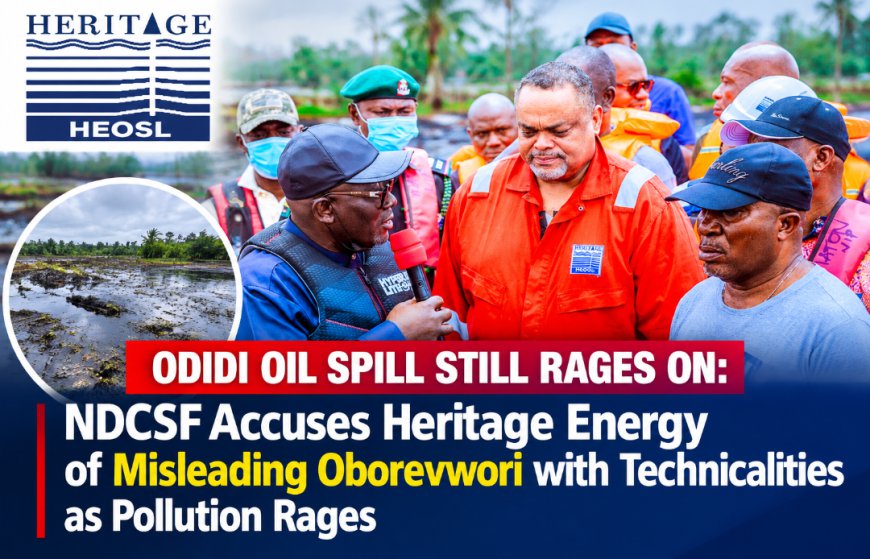
Odidi Oil Spill: NDCSF fumes over how Heritage allegedly fooled Gov Oborevwori with technicalities as pollution rages

By Martha Ebi


The Niger Delta Civil Society Forum (NDCSF) has accused Heritage Energy Operational Services Limited (HEOSL) of allegedly exploiting community divisions, deploying delay tactics and using the technical language of “clamping” to divert attention from the urgent demand to stop the prolonged crude oil pollution ravaging Odidi Federated Community in Warri South-West Local Government Area of Delta State.
The NDCSF called on Governor Sheriff Oborevwori, the Federal Government, environmental regulators, international human rights organisations and other concerned stakeholders to "look beyond official visits and promises and confront the company's failure to prioritise the safety, environment and livelihoods of the affected people".
These were contained in a statement issued by the NDCSF, and signed by its Coordinator, Comrade Ezekiel Kagbala, copies of which were made available to journalists in Warri on Saturday.
Heritage Energy Operational Services Limited, which operates the OML 30 asset on behalf of a joint venture involving NNPC Exploration and Production Limited and Shoreline Natural Resources Limited, has come under mounting criticism over its handling of the pollution crisis.
The NDCSF alleged that rather than treating the situation as an environmental emergency and taking immediate steps to stop the discharge, the company has allowed a leadership dispute in Odidi to deepen while crude oil operations allegedly continued through the compromised Trans-Forcados Pipeline associated with its operations in the area.
According to the NDCSF, the community's internal disagreements, including legal and other disputes, provided an opportunity for the company to continue its business activities while residents endured more than six months of environmental destruction and socioeconomic hardship.
The Forum further alleged that the prolonged leadership crisis effectively served a divide-and-rule strategy that weakened the community's collective response and allowed the company to continue operations amid growing environmental concerns.
NDCSF claimed that the strategy became particularly evident when the company reportedly delivered bags of rice, goat meat and vegetables to a rival faction within the community describing the gesture as "an attempt to strengthen divisions and consolidate the position of a parallel faction at a time when Odidi needed urgent intervention to stop the pollution, protect residents and restore damaged livelihoods".
The Forum argued that food items could not compensate for polluted waterways, damaged fishing grounds, threatened farmlands and the economic losses suffered by families dependent on the environment.
According to Kagbala, the alleged strategy began to unravel when the community chairman, Prince Preye Okrikpa, mobilised Odidi indigenes, civil society organisations and the media to expose the magnitude of the pollution and draw attention to the suffering of residents. He said the Organisation for Human and Peoples' Rights Protection and Humanitarian (OHPRPH) and the Niger Delta Civil Society Forum subsequently intensified their advocacy, condemning what they described as Heritage Energy's unwillingness to shut down the affected operations and stop the pollution.
Kagbala alleged that commercial considerations and the potential loss of profit influenced the company's reluctance to suspend operations, arguing that corporate interests must never take precedence over human safety and environmental protection.
The NDCSF coordinator further alleged that as public pressure mounted, Heritage Energy cultivated relationships with selected individuals in Odidi, empowered its preferred stakeholders and politicised the environmental crisis by involving the Chairman of Warri South-West Local Government Area, Hon. Sylvester Oromoni; Governor Oborevwori; and youth council representatives.
He claimed that the process effectively sidelined Okrikpa and the civil society groups demanding urgent action, shifting attention from stopping the pollution to stakeholder engagements and political consultations.
Kagbala argued that the development achieved precisely what the company wanted: a situation in which political attention focused on consultations and assurances without an immediate directive to shut down the affected operations and stop the source of the spill.
Kagbala expressed disappointment that Governor Oborevwori, whom he described as a respected and admired leader, did not issue an immediate order for the affected operations to be shut down and the source of the pollution stopped. He acknowledged the governor's stated commitment that the Delta State Government would not allow affected communities to suffer but questioned why the reported intervention did not include an explicit, immediate shutdown directive. According to him, Heritage Energy allegedly continued pumping crude oil while the community remained exposed to the consequences of the pollution.
He accused the company of swaying the governor with the technical language of “clamping”, which he argued diverted attention from the fundamental question of whether the source of the discharge had actually been stopped.
The governor reportedly directed the State Commissioner for Health to immediately deploy medical teams to assess affected residents and determine the health implications of the pollution. He also directed Heritage Energy Operational Services Limited to deploy its own medical team and provide relief materials.
While acknowledging the importance of these measures, Kagbala argued that medical assessments and humanitarian assistance could not replace immediate source control. He questioned the logic of deploying medical teams to examine the consequences of pollution while the source allegedly remained active, insisting that the first priority must be to prevent further crude oil from escaping into the environment.
He challenged the government to demand verifiable evidence that the reported clamping or containment measures had effectively stopped the discharge.
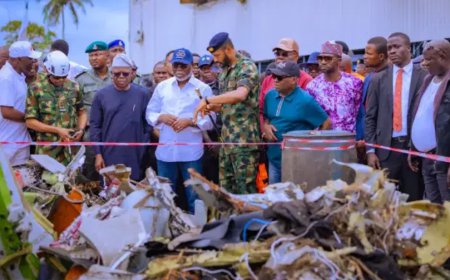
Oborevwori was accompanied on the inspection visit by the Speaker of the Delta State House of Assembly, Rt. Hon. Emomotimi Guwor, and the Chairman of Warri South-West Local Government Area, Hon. Sylvester Oromoni. Kagbala argued that the presence of senior government officials should have strengthened the urgency of the intervention and produced clear, enforceable measures to protect the affected community.
Instead, he warned that political engagements and official assurances risked creating the impression that sufficient action had been taken while the most critical questions about the spill, the compromised pipeline and the status of oil operations remained unanswered. He urged the governor and other political leaders not to allow corporate interests or community divisions to overshadow their responsibility to protect the people.
The civil society coordinator also warned of the potential long-term health consequences of prolonged exposure to oil pollution, raising concerns about the possibility of serious illnesses, including cancer. He called for credible medical assessments, environmental sampling and sustained health monitoring to establish the actual risks to residents.
Kagbala further cautioned that the company might no longer be present when the long-term consequences emerge, leaving families to bear the cost of illnesses, lost livelihoods and environmental destruction.
Kagbala called on the Federal Government, the Nigerian Upstream Petroleum Regulatory Commission, the National Oil Spill Detection and Response Agency, international environmental organisations and human rights groups to intervene urgently and independently establish the facts surrounding the Odidi pollution.
He also called for the restoration of affected waterways, fishing grounds and farmlands, alongside appropriate medical support and compensation where liability is established.
He insisted that the crisis must not be reduced to a political disagreement over community leadership or a public relations exercise dominated by official visits, stakeholder meetings and relief materials. The central questions, he said, remain whether the pollution has stopped.
Whether the environment is being restored and whether the affected people are receiving the protection and assistance they deserve. Kagbala maintained that neither a leadership dispute nor the commercial cost of suspending operations should justify allowing environmental damage to continue.
“Odidi cannot survive on political assurances, bags of rice or the language of clamping. The people need the pollution stopped, their environment restored and those responsible held accountable,” Kagbala's position underscores.
The NDCSF Coordinator warned that unless the Delta State Government and relevant federal authorities move beyond assurances to decisive enforcement, the people of Odidi could remain trapped in a prolonged environmental crisis in which commercial interests prevail while the community bears the human and economic cost.
What's Your Reaction?
 Like
0
Like
0
 Dislike
0
Dislike
0
 Love
0
Love
0
 Funny
0
Funny
0
 Angry
0
Angry
0
 Sad
0
Sad
0
 Wow
0
Wow
0